
Latest work
Krowned Hands
Mobile massage · Kingston & Montego Bay
A warm, premium one-page experience for Jordan’s mobile massage practice: clear session framing, trust-led typography, and a soft cream palette that mirrors the brand identity.


I design systems that facilitate structure, scalability, and clarity in complex digital products.
This process involves mind mapping flows and relationships: user-centered modules and testing that help shape the UI and overall user experience. This guides visual design and instructs brand cohesion, ensuring a seamless user journey.

End-to-end product: research, UI/UX, notifications, multi-screen flows, and a modular feature system built for real traders.

Standard Client Website Design.
Latest work
Mobile massage · Kingston & Montego Bay
A warm, premium one-page experience for Jordan’s mobile massage practice: clear session framing, trust-led typography, and a soft cream palette that mirrors the brand identity.
Case Study
Trading Companion App
FX Sesh is a mobile application I designed to help traders operate with more structure, awareness, and consistency.
Many retail traders rely on fragmented tools: switching between charts, news platforms, and journaling apps, which often leads to disorganized workflows and inconsistent decision-making.
I set out to design a unified system that simplifies this process, bringing key tools into a single, intuitive experience.
Through research and observation, I identified several recurring issues:
To address these challenges, I focused on designing a system that prioritizes clarity, speed, and usability without sacrificing functional depth.
My approach centered on reducing friction in daily workflows while encouraging consistency and informed decision-making.
This approach informed both the structure of the app and the features I prioritized.
Journaling system
I designed a structured journaling system to help traders track and evaluate their performance over time.
By integrating metrics such as win/loss ratio and average returns, the system encourages reflection and reinforces disciplined trading habits.
Session notifications
To improve market awareness, I implemented session-based notifications that alert users during key trading periods and session overlaps.
This helps traders align their activity with high-volume market conditions.
News integration
Due to the high cost of financial data APIs, I opted for an RSS-based solution: a deliberate trade-off that maintains relevant information while keeping the product lightweight and sustainable.
Learn tab
I introduced a curated learning section to support traders who are still developing their skills, so the app works as a resource, not only a utility.
These decisions shaped how I structured the interface and what I showed first in the UI.
The interface was designed to support fast decision-making and reduce cognitive load.
I focused on clear hierarchy, consistent spacing, and intuitive navigation so users can access key features quickly without unnecessary friction.
I organized the product as modules (sessions, alerts, journal, news, learn) that share one navigation model and brand system, so new features can plug in without breaking the whole. Primary session state reads first; depth stays one tap away when traders want it.
Primary: Outfit
Outfit
Regular · Medium · SemiBold · Bold


I designed the FX Sesh marketing site to match the app: same brand, clear value prop, and download CTAs so visitors can go straight to the store or beta.

Context assets → Interface → Outputs
This diagram illustrates how FX Sesh is structured as a modular system, where information inputs, user interactions, and feedback loops work together to support continuous trading decisions. Each feature is designed not as an isolated tool, but as part of an interconnected workflow that scales with user needs.

This system is designed as a continuous feedback loop where inputs inform decisions, actions are logged, and outcomes refine future strategies.

Modular design: each major area can evolve (e.g. journal or alerts) without collapsing the rest of the system, as long as navigation and session logic stay consistent.
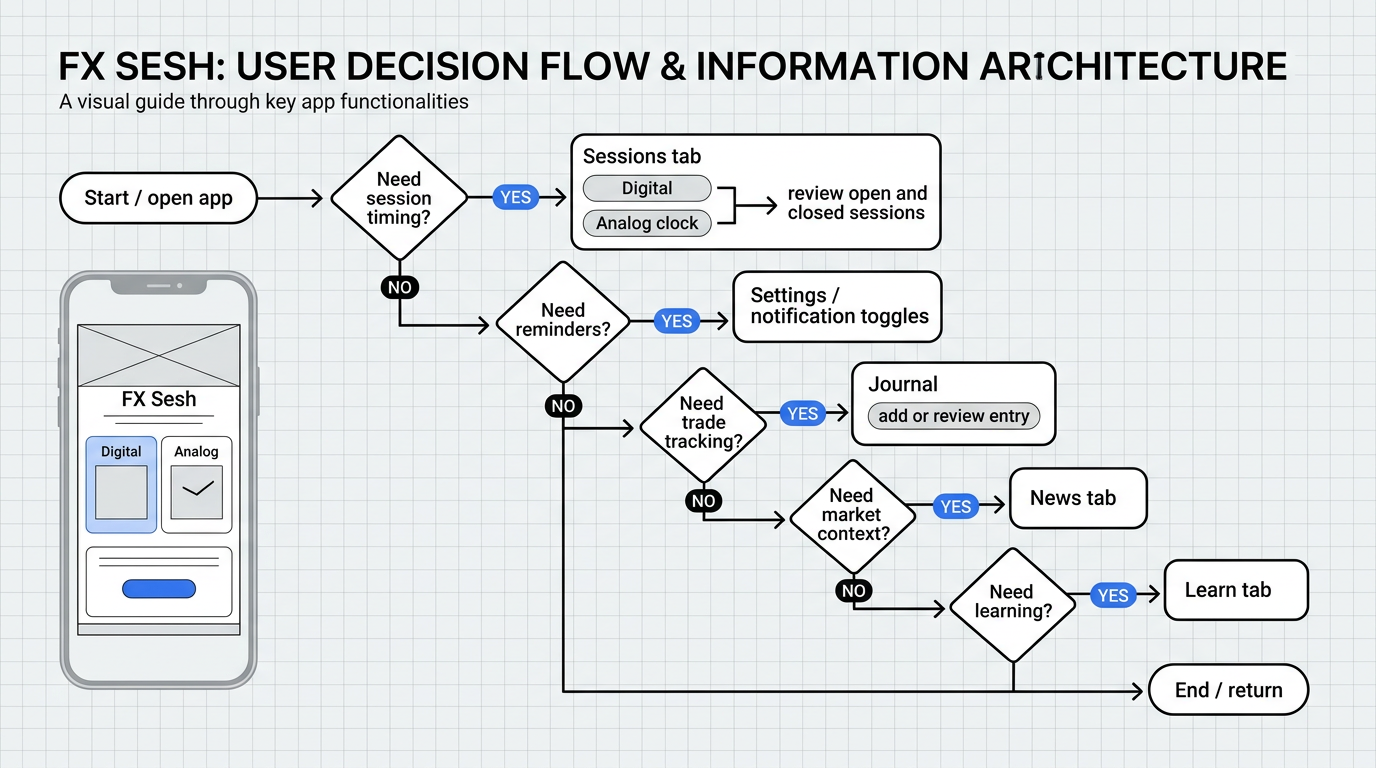
Where logic branches
This wireframe shows decision paths: if the user’s intent is session check vs. reminder setup vs. trade log vs. news, the product routes them without forcing a single highway. Same system as above, shown here with explicit if/then-style branching for reviewers who read flow.
I ran a focused beta-testing phase by reaching out to 15 testers and asking them to use the app in real trading scenarios, then share opinions on clarity, ease of use, and overall usefulness. Their feedback directly shaped the next round of updates: I refined UI details, improved screen clarity, and fixed bugs and functionality issues that surfaced during real use. That process helped move FX Sesh from a concept that worked in theory to a product that felt more stable, more intuitive, and more aligned with how traders actually check sessions, manage reminders, and navigate the app day to day.
Languages, frameworks, and tools used to ship the FX Sesh mobile app, integrations, and the companion marketing site.
Throughout development, several constraints influenced key decisions and shaped the final product:
Shipping FX Sesh meant choosing under real limits: cost, time, what the stack can do, and how the product should feel day to day. Each row below is the problem as it showed up, then what I gave up or kept instead.
This project reinforced the importance of balancing usability, performance, and sustainability when building real-world products.
It also highlighted the value of designing systems, not just interfaces, that support long-term user behavior and decision-making.
Case Study
Visual refresh for a Jamaican law firm. 44 years of legal services, with a clear, trustworthy site for practice areas, attorneys, and contact.
Headings: Libre Baskerville
Libre Baskerville
Regular · Bold · Italic
Body: Source Sans 3
Source Sans 3
Regular · Medium · SemiBold · Bold